Why Email Infrastructure Matters
Whether you’re sending marketing campaigns or critical transactional messages like password resets and order confirmations, email remains one of the last truly neutral communication channels: no Meta algorithms, no Google ad auctions, just direct communication with your audience. In an era of platform dependency, this direct relationship is increasingly valuable.
However, most organizations default to AWS Simple Email Service (SES) or services built on top of it. The reason is straightforward: AWS SES is exceptionally cost-effective. But this convenience comes at the cost of deeper dependence on US infrastructure, a concern that’s particularly relevant for European organizations navigating data sovereignty and strategic autonomy.
This guide focuses on programmatic email infrastructure: transactional emails (password resets, order confirmations) and marketing campaigns sent via APIs or SMTP. Corporate mailboxes (Exchange Online, Google Workspace) present their own sovereignty challenges, which I plan to cover in a future post.
Evaluating European Alternatives
Working with Volt Europa, my colleague Nicolai and I evaluated several European email service providers. Our primary candidates were EmailLabs and Lettermint. We also considered Scaleway Transactional Email (TEM), but its scope is limited to transactional emails only.
Our evaluation criteria were clear:
- Infrastructure hosted within Europe
- European-owned infrastructure stack (not just hosted in EU, but independent of US cloud providers)
- Competitive pricing and features
- Support for both transactional and marketing emails
While EmailLabs is European-owned, their infrastructure relies on Cloudflare and AWS, meaning a significant portion of costs still flows to US providers. For organizations committed to reducing US infrastructure dependency, this creates a conflict. Lettermint, by contrast, hosts their infrastructure on OVH and uses exclusively European services, making them the better fit for our requirements.
Why Not Self-Host?
A natural question arises: why not run your own mail server? After all, if the goal is independence from third parties, self-hosting seems like the logical endpoint. However, email is one of the few services where self-hosting is almost never worth the effort.
The core challenge is deliverability. Running an email server is technically straightforward; getting your emails into recipients’ inboxes is not. Major providers (Gmail, Outlook, Yahoo) maintain aggressive spam filtering that treats unknown IP addresses as guilty until proven innocent. Your fresh server IP was probably used by spammers in 2015, and that reputation follows it. You’ll spend more time managing IP reputation, SPF/DKIM/DMARC configurations, and debugging why your emails land in spam than actually building your product.
Beyond deliverability, there’s the operational burden: 24/7 monitoring, security patching, bounce handling, complaint processing, and the inevitable 3 AM alerts when something breaks. For SMBs and startups, this expertise is rarely available in-house, and the opportunity cost is significant.
The first webpage I encountered from Lettermint was justfuckinguselettermint.com, and their opening argument against self-hosting resonates: “You’ll spend more time babysitting Postfix, Dovecot, and certbot than actually building your product.” Self-hosting makes sense for hobbyists learning email infrastructure or organizations with dedicated email operations teams. For everyone else, a managed European provider offers the sovereignty benefits without the operational overhead.
Lettermint: Platform Overview
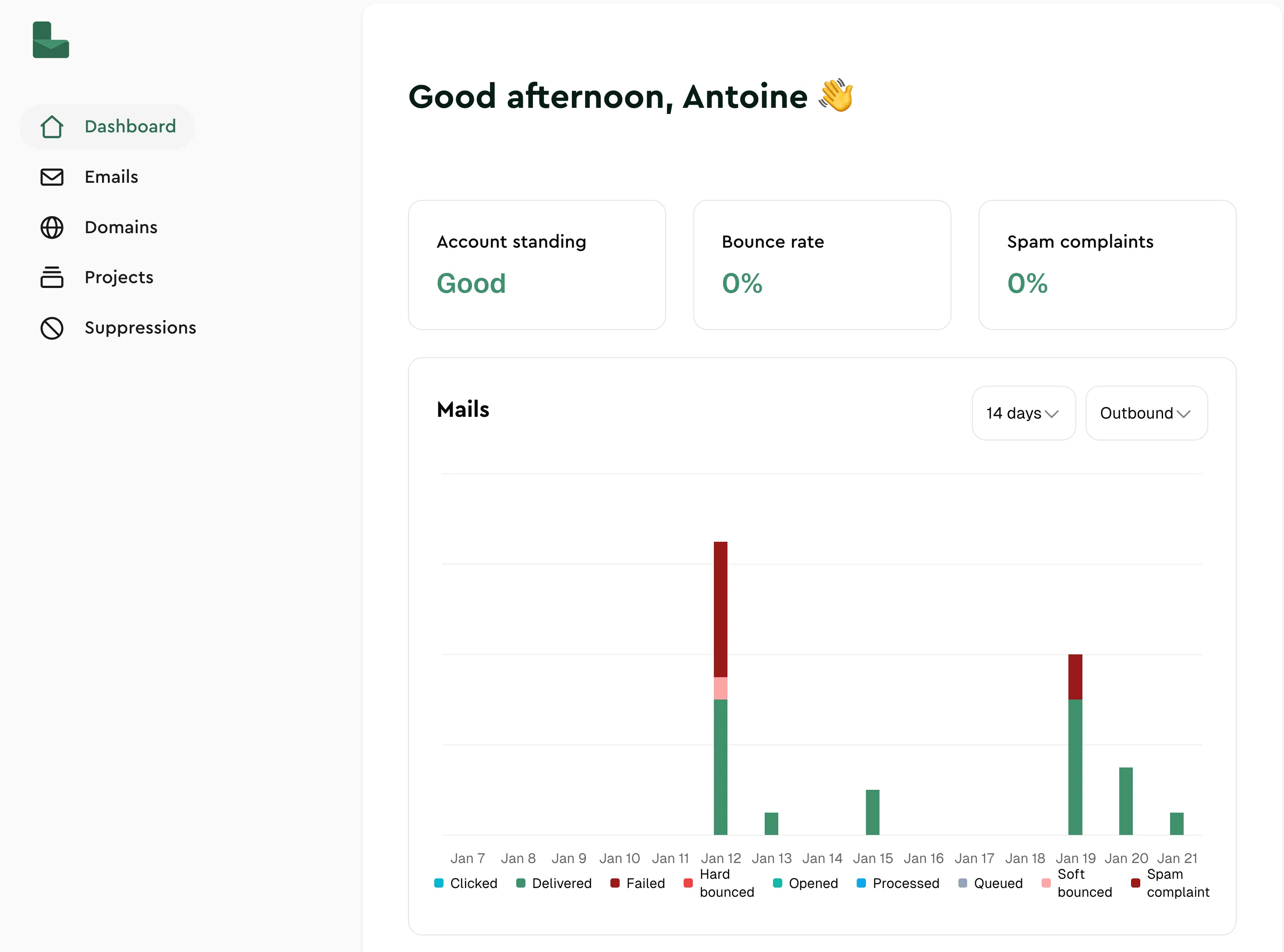
Lettermint is a relatively new player in the email infrastructure space. During my evaluation, I discovered that one of the founders is based in my city in the Netherlands, which led to an in-person meeting at their office. Their vision for building a genuinely European alternative was clear, and their commitment to the project was evident. This is clearly a mission-driven company, not just another SaaS clone.
Platform Features
The Lettermint platform offers several advantages over traditional providers:
Email Tracking and Visibility The dashboard provides real-time status tracking for every email (queued, processed, delivered), giving you complete visibility into your email pipeline. This level of transparency is crucial for debugging delivery issues and monitoring performance.
Domain-Based Project Architecture Lettermint’s approach to organizing email sending is particularly well-designed. The workflow is:
- Add and verify your domain
- Create projects (e.g., “transactional”, “marketing”, “notifications”)
- Enable SMTP or API access per project
- Configure domain-level project permissions
The domain permissions model is especially powerful: you can select which projects can use a domain for sending emails, and if none are selected, all projects are allowed by default.
This means you can create fine-grained access controls, ensuring that only specific projects can send from specific domains. For example, I can restrict my transactional email project to only send from my primary domain, while marketing campaigns use a separate subdomain. This separation improves both security and deliverability, a significant improvement over AWS SES’s more monolithic approach.
Room for Improvement
Single Sign-On (SSO) Currently, Lettermint doesn’t offer SSO, though it’s planned for Q2 2026. I’m hoping this evolves to include both OIDC and SCIM support across all tiers as the platform matures. SSO should ideally be a security feature, not a premium add-on. The practice of SSO tax undermines security for smaller organizations that need it most.
Pricing Strategy
Lettermint’s pricing is competitive among European providers, though AWS SES remains significantly cheaper at scale. Direct comparison is tricky because the pricing models differ fundamentally: AWS SES uses simple per-email pricing ($0.10 per 1,000 emails), while Lettermint uses volume-based tiers where your base price depends on your expected monthly volume.
| Volume (monthly) | AWS SES | Lettermint | EmailLabs |
|---|---|---|---|
| 50,000 emails | ~$5 | €45 | €29 |
| 125,000 emails | ~$12.50 | €100 | ~€95 |
| 1,500,000 emails | ~$150 | €720 | ~€1,095 |
| Effective CPM | ~€0.09 | €0.48-0.90 | €0.58-0.76 |
The price difference is real, but context matters. AWS SES’s low price comes with trade-offs: sandbox restrictions that can take weeks to lift, opaque account suspensions, and support that routes through generic AWS channels. Lettermint offers direct support from a small team that understands email deliverability. For mission-critical transactional emails, that responsiveness has value.
This creates a strategic decision for organizations:
Hybrid Approach (Cost-Conscious)
- Transactional emails via Lettermint: These are typically low-volume but mission-critical (password resets, order confirmations, account notifications). Keeping them in Europe ensures your most important communications are under your control and comply with European regulations.
- Marketing emails via AWS SES: High-volume campaigns can leverage economies of scale while being less critical to core operations.
Full European Stack (Sovereignty-First)
- All emails via Lettermint: Migrating both transactional and marketing emails provides complete independence from US infrastructure.
- Best for: Organizations where data sovereignty is a compliance requirement or strategic priority.
The key insight: even a partial migration to European infrastructure for your transactional emails significantly reduces risk exposure while keeping costs manageable.
DMARCwise: Ensuring Email Deliverability
Earlier I mentioned that email is one of the last truly neutral communication channels, with no algorithms deciding who sees your message. But that neutrality comes with a trade-off: there’s also no platform guaranteeing delivery. When you post on social media, the platform handles distribution. With email, you’re responsible for proving your legitimacy to every receiving mail server.
This is where email authentication protocols (DMARC, SPF, DKIM) become critical. Without proper configuration:
- Your emails may land in spam folders
- Your domain can be spoofed by phishers
- You have no visibility into delivery issues
- Your sender reputation slowly degrades
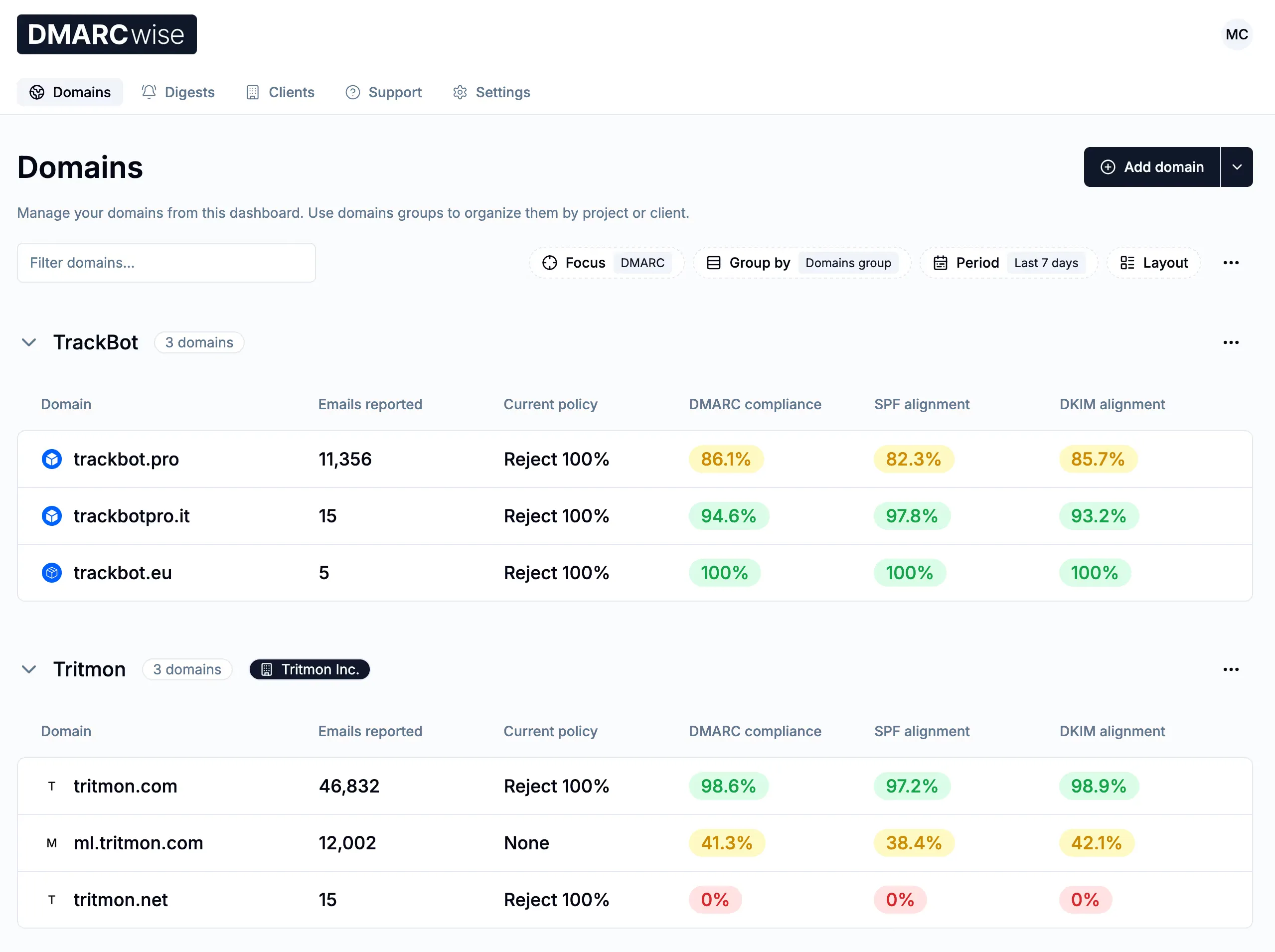
DMARCwise, identified by Nicolai during our research, helps you set up and monitor these authentication protocols. It ensures your emails reach the inbox while preventing others from impersonating your domain.
Platform Experience
DMARCwise excels at making complex email authentication accessible. The platform provides:
Clear Implementation Guidance Setting up DMARC, SPF, and DKIM can be intimidating; the specifications are dense, and mistakes can break email delivery. DMARCwise simplifies this with step-by-step configuration wizards and clear validation.
Ongoing Monitoring and Alerts Once configured, the platform continuously monitors your email authentication status and provides detailed reports on delivery issues, authentication failures, and potential spoofing attempts.
Managed DMARC Option For organizations without dedicated email infrastructure expertise, DMARCwise offers managed DMARC where they handle DNS configuration on your behalf.
Rather than requiring full DNS zone access, they use a CNAME-based approach:
- You create a single CNAME record pointing
_dmarc.yourdomain.comto their servers - They serve the actual DMARC policy from their infrastructure
- You update policies through their interface with changes propagating automatically
This means you only delegate control of that specific DNS record, not your entire zone. While this requires trusting DMARCwise with your DMARC record, it’s a pragmatic solution for startups and SMBs: correct DMARC configuration managed by experts is vastly better than no DMARC at all.
Authentication and Access Management
SSO Availability DMARCwise includes SSO on most paid tiers (excluding only the starter tier). While some might argue that SSO is unnecessary for small teams, I disagree: secure authentication should be standard, not a premium feature. The current implementation uses SAML. While OIDC is technically more modern (avoiding XML complexity and signature vulnerabilities), SAML was a pragmatic choice for enterprise compatibility. Major identity providers like Microsoft Entra ID and Google Workspace make SAML integration straightforward. For organizations using modern open-source identity providers like Authentik, Logto, or Keycloak, OIDC support would be welcome, but the current SAML implementation is solid and works well.
Support and Philosophy
DMARCwise is run by Matteo, who provides exceptional support: responsive, knowledgeable, and genuinely helpful. The company’s philosophy page is worth reading; it accurately reflects the product’s approach to solving real problems without unnecessary complexity.
Building a European Email Stack
Here’s my recommended approach for migrating to European-hosted email infrastructure based on hands-on experience:
Migration Strategy
Phase 1: Critical Infrastructure Start by migrating transactional emails to a European provider (in my case, Lettermint). These are your password resets, order confirmations, and system notifications: low volume but business-critical. This immediately reduces your exposure to US infrastructure for your most important communications.
Phase 2: Email Authentication Implement proper DMARC, SPF, and DKIM configuration (I use DMARCwise for this). This step is non-negotiable regardless of which email provider you use. Proper authentication protects your domain reputation and ensures deliverability. For best practices, see this guide to DMARC compliance.
Phase 3: Full Migration (Optional) If budget allows and data sovereignty is a priority, migrate marketing emails to your European provider as well. This completes your independence from US infrastructure.
Why This Matters
Email infrastructure might seem like a mundane technical choice, but it represents something larger: the ability to control your own digital infrastructure without dependence on foreign tech giants. For European organizations navigating increasing regulatory complexity and geopolitical uncertainty, building on European infrastructure is both a compliance advantage and a strategic hedge.
Both Lettermint and DMARCwise demonstrate that European alternatives can compete on features, usability, and support, not just on ideology. They’re genuinely good products that happen to be European, which is exactly what the ecosystem needs.
Next Steps
Ready to build your European email infrastructure? Here’s how to start:
- Migrate critical emails first: Set up Lettermint for transactional emails (password resets, order confirmations, account notifications)
- Protect your domain: Configure DMARC with DMARCwise to ensure deliverability and prevent spoofing
- Follow this series: Subscribe via RSS or connect with me on LinkedIn for more practical guides on European cloud sovereignty and open-source infrastructure alternatives
Questions about migrating your email infrastructure? Feel free to reach out.